


It's a New Year: Trends Point to Importance of Content Discovery
Every January, Media & Entertainment (M&E) industry leaders and analysts take stock of the past year, identify the biggest trends and priorities, and put a pin in their predictions for the year ahead. 2020 was a year unlike any other, but the January habits of reflection and prediction continue.
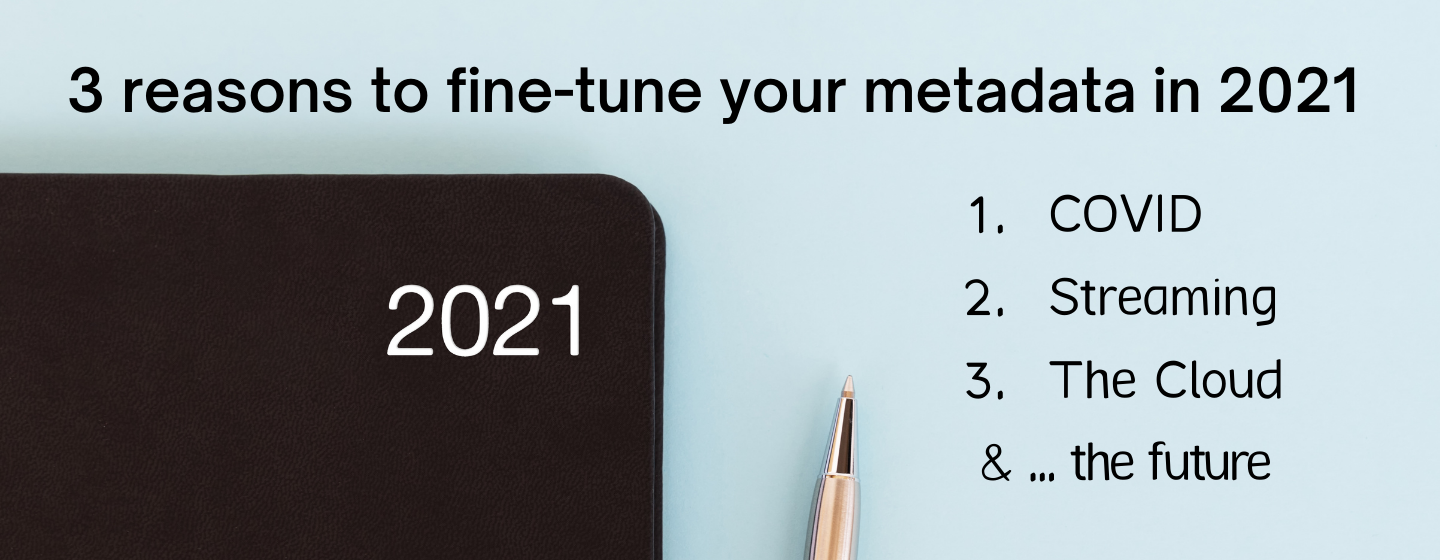
We’ve spent the past few weeks combing through media and technology trade publications and listening in at CES 2021 (the Consumer & Electronics Show) and other end-of-year or new year events. As was the case last year, the biggest media technology trends all have implications for the way you “do metadata.” Here’s a quick rundown of the top 3 trends that will have you wanting to fine-tune your program metadata.
1. COVID as Catalyst
“We’ve seen two years’ worth of digital transformation in two months."—Satya Nadella, CEO, Microsoft, CES 2021 Keynote
It’s almost impossible to find an end-of-year roundup that doesn’t point to the impact of COVID on the pace of innovation. Looking at a wide range of industry sources, the consensus is that the pandemic accelerated operational improvements and innovations that would otherwise have taken at least 3-5 years to implement.
IP content delivery. Remote work and production. End-to-end cloud-powered operations. Though these digital transformation efforts were already a work in progress for most media companies, including PBS, the pandemic meant they all had to happen much sooner than planned. As PBS CTO Mario Vecchi put it on a recent DPP Media Technology Leaders’ panel, “We were in a position of having to make some lemonade.”
Why This Matters for Public Media: In a perfect world, we would have had a bit more time to get the details of our remote workflows and operations perfect. While everyone has managed to respond with resilience and creativity during a challenging time, there are small changes to the way content creators “do metadata” that can ultimately have a big impact on audiences' ability to discover our content. Giving all staff access to “a single source of metadata truth,” for example, would ensure that metadata going out to press, platforms, and partners is as early and as accurate as possible, which in turn will make it easier for audiences to connect with your content. (It would also ensure that different teams aren't actually publishing contradictory details about the same show!) Even a solution as simple as a spreadsheet on your intranet or another shared space will work. Making sure the metadata is industry-standard (which is another focus of the Metadata Co-op's webinar series), will help even more.
2. We Are All, “All In” on Streaming
You weren’t the only one to spend more of your extra indoor time watching any of the 200+ streaming services now available. Pre-pandemic, most households subscribed to an average of 2-3 streaming services. In 2020, that average shot up to between 4 and 5 (with a big chunk of households making use of as many as 8-10.)
"In 2021, for the first time ever, more people will pay for online video services globally than for pay TV, and the associated increase in spending across video streaming now means that online video has become the largest source of TV and video revenue globally."—TBI Vision 2021 Report
Why This Matters for Public Media: Two reasons. First, the sheer volume of content and the overwhelming number of platforms now makes it statistically less likely that audiences will discover your show when they’re browsing for something to watch. Recommendation and search algorithms rely heavily on metadata, so everything you can do to make your metadata robust and industry-standard will help connect audiences with your content. Which brings us to Streaming reason number 2. Chances are that you are (or soon will be) working to get your own content out to more streaming partners—each of which has their own metadata requirements and specifications. Knowing what each platform needs and making your metadata publishing workflowsas efficient as possible will become more important as you work with more platforms.
At the Metadata Co-op we've done some work to identify the most frequently used industry standards—sort of a "one spec to rule them all." By using the Metadata Model for Content Discovery as a baseline, you can organize your program metadata by starting with the fields and specifications most frequently requested in our industry. To learn more about the Metadata Model for Content Discovery, watch the Metadata 102 Webinar recording here.
3. Cloudy and Getting Cloudier
“We can all easily go ‘into’ the Cloud ... but without some common way to track your assets properly through a software-defined workflow as described by the [MovieLabs white paper on software-defined workflows], it would be just like going into grandma’s attic—you won’t be able to efficiently find anything.”—SMPTE Newswatch
Streaming and the Cloud go hand-in-hand, and the pandemic has highlighted the enormous utility of the Cloud for the greatest possible level of flexibility in operations, production, and "geo-agnostic" work in general. In the cloud, however, finding, tracking, and ensuring an audience's ability to discover content they didn't know existed depends on metadata, including unique identifiers.
Why This Matters for Public Media: In a cloud-driven supply chain, every piece of content—and every version of every piece of content—needs a unique identifier or it quickly becomes impossible to keep track of it. Books have ISBNs, groceries have UPC codes, and anyone behind the wheel of a car in the U.S. has a driver’s license ID. There are many IDs that are important in our industry—Gracenote TMS IDs and IMDb, for example, both assign unique identifiers to every movie and TV program that get registered in their systems (you can see IMDb IDs in the URL for each show, whereas Gracenote's IDs are proprietary and you have to subscribe to get them). In fact, most identifiers for your programs are proprietary, which means you don’t have much control over the data that gets associated with them, and you can’t repurpose them or cross-link with them (or at least not for free).
The Entertainment Identifier Registry (EIDR) is the dominant, non-proprietary, unique identifier in our industry, used by all of the top global media companies, network giants, and film studios. (See the list here.) The Registry is openly searchable at eidr.org, and the IDs get picked up by search and discovery partners such as Google and others, which means that taking the time to post the 20 required fields of data about each show to EIDR is probably time well spent. (Learn more at our "Introduction to EIDR" webinar by registering here.)
And then there's the future...
"The quality of descriptive TV program information sits at the heart of a TV business. It is fundamental to the user experience, content discovery and recommendation.... When you have accurate data, you also stand the best chance of leveraging it." — Janet Greco, "Metadata is the Answer—and the Problem, OTT Executive Magazine, Fall 2019
There will always be new industry and technology trends, and consumers will continue to evolve in their viewing needs and preferences because that’s how the future works. Media organizations that are ready with a "single source truth" and program metadata that is well organized, accurate, and industry-standard will benefit most from the many ongoing efforts industry-wide to improve content discovery—and they will be ready for whatever comes next.
Visit metadata.pbs.org to learn more about what public media stations and producers can do to make sure program metadata is future-ready.
Are You Getting the Metadata Co-op's Monthly Newsletter?
To get stories like this one delivered to your inbox on a monthly basis, opt in here.
Sources
DPP Tech Leaders’ Briefing 2020 | DPP - the Media Industry’s Business Network. Streaming, 2020. https://www.thedpp.com/replay/tech-leaders-briefing-2020/video/49584/6210953871001. Note, you can watch all DPP panels, including the one featuring PBS CTO Mario Vecchi, at this link (free access after you register). Highly recommended. Insights from global media leadership.
“The DPP 2021 Predictions.” Media Technology Predictions. DPP (Digital Production Partnership), February 3, 2021. https://www.thedpp.com/news/dpp-release-2021-predictions.
Goldman, Michael. “Reimagining Software-Defined Workflows.” SMPTE Newswatch. Accessed February 10, 2021. https://www.smpte.org/blog/cloud-production-on-the-horizon-0.
Greco, Janet. “Metadata Is the Answer - and the Problem.” OTT Executive Magazine, no. Fall (December 3, 2019). https://www.broadcastprojects.com/news/metadata-is-the-answer-and-the-problem Note: This article provides an outstanding historical perspective on why those in the broadcast industry have not typically managed their own metadata. Once at that URL look for the link that says "Read the full article" to download the PDF. Highly recommended reading!
Herrera, Adrian. “Everything Must Be Online.” M & E Journal, no. Winter 2020/2021 (December 2020): 103–4, 138. https://www.mesaonline.org/publication-archive/
Middleton, Richard and Aguete, Maria Rua. TBI Vision. “TBI Tech & Analysis: Emerging Super-Trends for 2021,” October 26, 2020. https://tbivision.com/2020/10/26/tbi-tech-analysis-emerging-super-trends-for-2021/.
MovieLabs. “Our New 2030 Vision Paper on Software-Defined Workflows,” October 30, 2020. https://movielabs.com/our-new-2030-vision-paper-on-software-defined-workflows/.
Pennington, Adrian. NAB Amplify. “CES 2021: 10 Takeaways for Media and Technology Professionals.” Accessed February 10, 2021. https://nabshow-beta.go-vip.net/amplify/articles/ces-2021-10-takeaways-for-media-and-technology/.
Pierce, David. “Source Code at CES: The Robots Are in Charge.” Protocol — The people, power and politics of tech, January 14, 2021. https://www.protocol.com/source-code-ces-robots-gm.
Ramsammy, Andrew. “10 Things Public Media Should Forget and Consider in 2021.” Current, January 10, 2021. https://current.org/2021/01/10-things-public-media-should-forget-and-consider-in-2021/.
Rua Aguete, Mari. “2021 Trends to Watch: Media and Entertainment Super-Trends.” Annual Trends. Omdia, October 23, 2020. https://omdia.tech.informa.com/OM014310/2021-Trends-to-Watch-Media-and-Entertainment-Super-trends.
Spataro, Jared. “2 Years of Digital Transformation in 2 Months.” Microsoft 365 Blog, April 30, 2020. https://www.microsoft.com/en-us/microsoft-365/blog/2020/04/30/2-years-digital-transformation-2-months/.